Three things that make an AGV a hard radio case
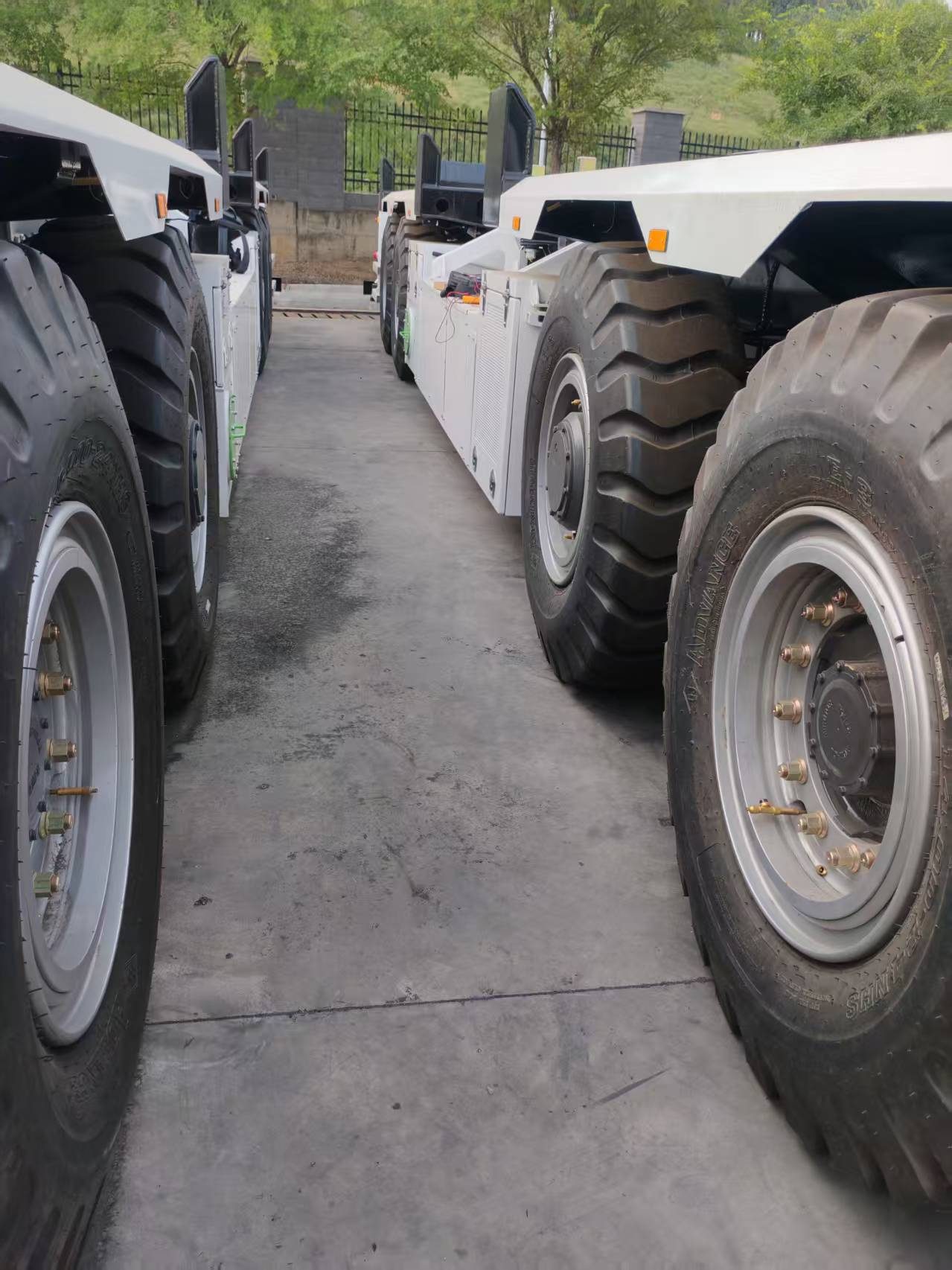
An AGV crawls compared with a truck, so the intuitive expectation is that its TPMS is easy. It is
not, for three reasons that have nothing to do with speed:
1. A steel frame under steel boxes. The wheels sit under a body that is, in radio terms, a
grounded steel plate with containers on top.
2. Dense parking. AGVs stack close together, so neighbouring machines and their steel bodies are
inside the same radio space.
3. The receiver goes where the harness ends. On an AGV the controller bay is often at one end,
so the receiver is at one end too, and the far wheels are behind structure.
What we measured
Two port AGVs of the same type, no repeater, receiver mounted in the same location on both machines.
One run monitored only the four right-hand wheel positions, the other **only the four left-hand
positions**, each for 18–21 minutes of continuous CAN logging.
Loss was counted the way we always count it: every sensor increments a counter in its payload, cycling
`0x00` to `0x28`; a gap in the sequence is a lost packet, and loss = lost / (received + lost).
| Wheel position | Right side | Left side |
|---|---|---|
| 0x11 | 10.59% | 10.62% |
| 0x12 | 8.45% | 14.98% |
| 0x13 | 5.45% | 6.47% |
| 0x14 | 8.90% | 6.64% |
| 0x21 | 8.31% | 37.61% ⚠️ |
| 0x24 | 7.87% | 13.36% |
| Average | 8.3% | 15.0% |
The one number that is not a radio result
The left-side run shows 37.61% on 0x21, and next to it 324 packets with a repeated counter —
packets arriving while the counter stood still. That is a sensor or forwarding anomaly, not a radio
path that suddenly failed. Publishing it as "signal quality" would be wrong, so we publish it as what
it is: a position whose counter behaviour needs investigating before anyone redesigns an antenna
around it.
What the rest of the table says, and it is the useful part: on the same machine, the two sides
differ by roughly a factor of two in average loss (8.3% against 15.0%), and the best position (0x13)
stays best on both sides. That is a receiver-position story, not a sensor story.
What we do on a port AGV
1. Receiver low and central, near the axle, not in the controller bay at one end.
2. One repeater at the far end if the machine is long enough that the far wheels sit behind the
frame — then measure again rather than assume.
3. Check the counter, not just the pressure. An AGV with a stuck counter reports a plausible
pressure forever; the counter is what tells you the wheel is actually being heard.
4. Plan the parking layout. Two AGVs nose to nose is a different radio environment from one AGV
alone; it is worth one measurement in the real stack.
What we will not claim
We will not publish a "range for AGVs". The AGV case is decided by where the receiver can go and what
steel is between it and the wheels, and that changes with the terminal layout.
FAQ
Is a slow machine easier for TPMS? No. Speed does not change the radio path; steel, distance and
parking density do.
Why measure left and right separately? Because a receiver mounted on one side is nearer to that
side's wheels — the difference is large enough to change the answer (8.3% against 15.0% here).
Do you use a repeater on AGVs? Only when the machine geometry needs it, and after measuring. On
these two machines it was not used.
Can the same receiver serve a whole AGV fleet? One receiver per machine; up to 256 wheel positions
each, so capacity is not the constraint — radio layout is.